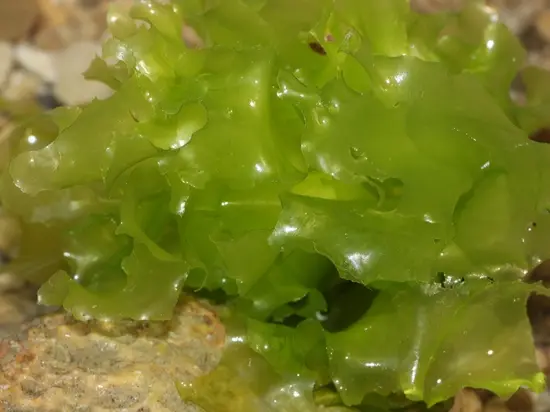


Ulva lactuca (Sea Lettuce) — Organic Seaweed Powder
- Vitamin C
- Magnesium
- Protein
- Iron
- Iodine
- Ulvan
On request


DE-ÖKO-070
EU agriculture
Product Overview
Ulva lactuca, commonly known as sea lettuce, is a certified organic green macroalga found on coastlines worldwide. Its powder is valued across the food, feed, agriculture, pharmaceutical, and cosmetic sectors, both for its natural nutrient density (vitamin C, magnesium, iron, iodine, and protein) and for its content of ulvan, a sulfated polysaccharide studied for a wide range of bioactive properties.
Typical applications: Ulva lactuca (Sea Lettuce) — Organic Seaweed Powder
Nutritional / Functional Highlights
- Nutrient profile: Ulva lactuca naturally provides vitamin C, magnesium, iron, iodine, and protein, alongside a range of other micro and macro nutrients [4, 5].
- Ulvan content: Ulva lactuca is a rich source of ulvan, a sulfated polysaccharide studied for antioxidant, antimicrobial, antiviral, and anticoagulant activities [8, 9, 11, 12, 13, 14].
- Immune and gut support: Research suggests ulvan can support immune modulation and gut health [8, 9, 11, 12, 13, 14].
- Wound healing: In vitro and in vivo evaluation has demonstrated wound-healing properties [11].
- Anti-inflammatory activity: Methanol extracts have shown anti-inflammatory activity in animal studies [12].
- Antimicrobial and antifungal activity: Extracts have demonstrated activity against clinically relevant Staphylococci and pathogenic fungi [13, 14].
- Emerging applications: Ulvan is also being explored for biodegradable packaging and as a plant biostimulant [8, 9].

Typical applications
- Food products and dietary supplements, including sea salad, pasta, and seasoning mixtures [3, 6, 7]
- Animal feed additive, contributing a variety of micro and macro nutrients [4, 5]
- Agricultural fertilizer and biostimulant, owing to its trace element and mineral content
- Pharmaceutical and cosmetic raw material via ulvan extraction [8, 9, 11, 12, 13, 14]
- Emerging use in biodegradable packaging materials [8, 9]
Product information: Ulva lactuca (Sea Lettuce) — Organic Seaweed Powder
Technical Specifications
| Colour | Green |
| Appearance | Fine Powder |
| Density (untapped) | 500 to 700 g/L |
| Loss on drying | ≤ 15,0 % |
Production / Cultivation Notes
Ulva lactuca occurs naturally on sea coasts worldwide. Harvested biomass is cleaned, dried, and milled to produce a stable powder. Harvesting conditions, location, and season may cause variation between production batches.
Ordering & Contact
We supply Ulva lactuca powder in bulk for B2B buyers across the food, feed, agriculture, pharmaceutical, and cosmetic sectors. A conventional (non-organic) variant is also available. Delivery time is available on request. Contact us to request a quote, discuss volume requirements, or obtain a product specification sheet.
FAQ — Frequently Asked Questions
What is Ulva lactuca?
Ulva lactuca, also known as sea lettuce, is a green macroalga found on sea coasts almost worldwide [1, 2].
What is Ulva lactuca powder used for?
The powder is used across multiple industries: as a food ingredient and dietary supplement, as an animal feed additive, as an agricultural fertilizer, and as a source of ulvan for pharmaceutical, cosmetic, and biodegradable packaging applications [3, 4, 5, 6, 7, 8, 9].
What is ulvan and why does it matter?
Ulvan is a sulfated polysaccharide found in Ulva lactuca. It has been studied for antioxidant, antimicrobial, antiviral, and anticoagulant activities, and is being explored for immune modulation, wound healing, gut health, biodegradable packaging, and plant biostimulants [8, 9, 11, 12, 13, 14].
Which vitamins and minerals does Ulva lactuca contain?
Ulva lactuca naturally provides vitamin C, magnesium, iron, and iodine, alongside protein [4, 5].
What industries use Ulva lactuca powder?
Ulva lactuca powder is used in the food, animal feed, agriculture, pharmaceutical, and cosmetic industries, with its ulvan content of particular interest to the pharmaceutical, cosmetic, and agricultural sectors [8, 9, 11, 12, 13, 14].
Is this Ulva lactuca product certified organic?
Yes. This product is certified organic under the DE-ÖKO-070 standard (EU agriculture) and produced in accordance with ALGANEX quality certification.
Is Ulva lactuca suitable for use in agriculture and cosmetics?
Because of its trace element and mineral content, Ulva lactuca is used as a fertilizer, and its ulvan content is studied for cosmetic and pharmaceutical applications including wound healing and antimicrobial activity [8, 9, 11, 12, 13, 14].
Sources:
- Ulva lactuca - G.M. Guiry in Guiry, M.D. & Guiry, G.M. 19 August 2024. AlgaeBase. World-wide electronic publication, National University of Ireland, Galway. (https://www.algaebase.org/search/species/detail/?species_id=39)
- Ulva lactuca - Wikipedia (https://en.wikipedia.org/wiki/Ulva_lactuca)
- Dominguez H, Loret EP. Ulva lactuca, A Source of Troubles and Potential Riches. Mar Drugs. 2019 Jun 14;17(6):357. doi: 10.3390/md17060357. PMID: 31207947; PMCID: PMC6627311. (https://pubmed.ncbi.nlm.nih.gov/31207947/)
- Sırakaya S. Pros and cons of Ulva lactuca and Cladophora glomerata grown in freshwater as feed. Environ Sci Pollut Res Int. 2023 Mar;30(12):33446-33454. doi: 10.1007/s11356-022-24532-1. Epub 2022 Dec 8. PMID: 36480141. (https://pubmed.ncbi.nlm.nih.gov/36480141/)
- Bikker P, van Krimpen MM, van Wikselaar P, Houweling-Tan B, Scaccia N, van Hal JW, Huijgen WJ, Cone JW, López-Contreras AM. Biorefinery of the green seaweed Ulva lactuca to produce animal feed, chemicals and biofuels. J Appl Phycol. 2016;28(6):3511-3525. doi: 10.1007/s10811-016-0842-3. Epub 2016 Apr 23. PMID: 28035175; PMCID: PMC5155021. (https://pubmed.ncbi.nlm.nih.gov/28035175/)
- Adrien A, Dufour D, Baudouin S, Maugard T, Bridiau N. Evaluation of the anticoagulant potential of polysaccharide-rich fractions extracted from macroalgae. Nat Prod Res. 2017 Sep;31(18):2126-2136. doi: 10.1080/14786419.2017.1278595. Epub 2017 Feb 1. PMID: 28147712. (https://pubmed.ncbi.nlm.nih.gov/28147712/)
- Hela Yaich, Haikel Garna, Souhail Besbes, Michel Paquot, Christophe Blecker, Hamadi Attia, Chemical composition and functional properties of Ulva lactuca seaweed collected in Tunisia, Food Chemistry, Volume 128, Issue 4, 2011, Pages 895-901, ISSN 0308-8146, (https://www.sciencedirect.com/science/article/pii/S0308814611005152)
- Cindana Mo’o, F. R., Wilar, G., Devkota, H. P., & Wathoni, N. (2020). Ulvan, a Polysaccharide from Macroalga Ulva sp.: A Review of Chemistry, Biological Activities and Potential for Food and Biomedical Applications. Applied Sciences, 10(16), 5488. (https://doi.org/10.3390/app10165488)
- Barakat, K.M., Ismail, M.M., Abou El Hassayeb, H.E. et al. Chemical characterization and biological activities of ulvan extracted from Ulva fasciata (Chlorophyta). Rend. Fis. Acc. Lincei 33, 829–841 (2022). (https://doi.org/10.1007/s12210-022-01103-7)
- Malvis Romero, A., Picado Morales, J. J., Klose, L., & Liese, A. (2023). Enzyme-Assisted Extraction of Ulvan from the Green Macroalgae Ulva fenestrata. Molecules, 28(19), 6781. (https://doi.org/10.3390/molecules28196781)
- Wang CH, Huang ZT, Tai KF. In vitro and in vivo evaluation of Ulva lactuca for wound healing. PLoS One. 2025 Jan 8;20(1):e0311037. doi: 10.1371/journal.pone.0311037. PMID: 39775568; PMCID: PMC11709284. (https://pubmed.ncbi.nlm.nih.gov/39775568/)
- Margret RJ, Kumaresan S, Ravikumar S. A preliminary study on the anti-inflammatory activity of methanol extract of Ulva lactuca in rat. J Environ Biol. 2009 Sep;30(5 Suppl):899-902. PMID: 20143726. (https://pubmed.ncbi.nlm.nih.gov/20143726/)
- Deveau AM, Miller-Hope Z, Lloyd E, Williams BS, Bolduc C, Meader JM, Weiss F, Burkholder KM. Antimicrobial activity of extracts from macroalgae Ulva lactuca against clinically important Staphylococci is impacted by lunar phase of macroalgae harvest. Lett Appl Microbiol. 2016 May;62(5):363-71. doi: 10.1111/lam.12563. PMID: 26958825. (https://pubmed.ncbi.nlm.nih.gov/26958825/)
- SR, SIVAKUMAR & Ramasamy, Krishnamoorthi. (2019). ANTIFUNGAL ACTIVITY OF SEAWEED ULVA LACTUCA L. EXTRACTED CRUDE PROTEIN AGAINST PATHOGENIC FUNGI. Asian Journal of Pharmaceutical and Clinical Research. 12. 393-396. 10.22159/ajpcr.2019.v12i3.30750. (https://www.researchgate.net/publication/331644767)
Reply within twelve hours