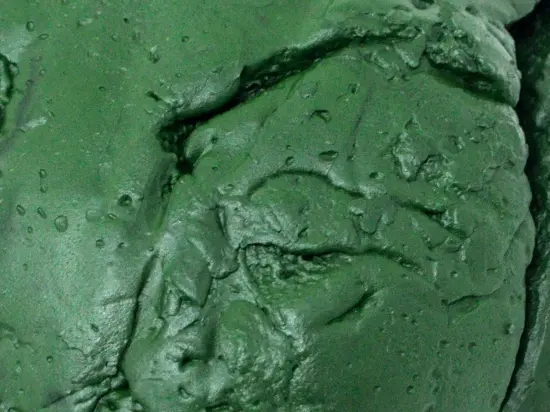


Spirulina platensis Fresh
- 100% raw
- Ready to use
- Biologically active nutrients
On Demand weeks

Product Information
Fresh Spirulina platensis refers to the cyanobacterium Spirulina platensis harvested and consumed in its live, raw, or fresh form. Unlike dried Spirulina powder or tablets, fresh Spirulina is an unprocessed product in which all enzymes and pigments remain biologically active and can perform their functions.[5, 6]
Fresh Spirulina platensis contains valuable proteins and vital substances such as carotenoids and phycocyanin.[5, 6] Because it is a natural raw food, none of its nutrients have been subjected to heat or drying processes. It has a milder flavour and a creamy consistency compared to dried Spirulina, making it suitable for direct consumption and ready-to-use food applications.
Fresh Spirulina paste is ready to use and does not need to be rehydrated like dried powder. For longer shelf life, it can be easily frozen in portions and added to meals as needed.
Typical applications: Spirulina platensis Fresh
Nutritional and Functional Highlights
- Biologically Active Nutrients — All enzymes and pigments remain active, as no heat or drying process is applied[5, 6]
- High Protein Content — Contains valuable proteins including all essential amino acids required by the body[5, 6]
- Phycocyanin — The characteristic blue pigment of Spirulina, present in its natural, unprocessed state. Acts as an antioxidant and free radical scavenger with demonstrated anti-inflammatory properties[3, 7]
- Carotenoids — Naturally occurring carotenoids retained in full due to the absence of heat processing[5, 6]
- Vitamins — Contains vitamins B1, B2, B3, B6, B12, vitamin E, and beta-carotene (a vitamin A precursor)[5, 6]
- Minerals — Naturally contains iron, potassium, magnesium, and zinc[5, 6]
- Antioxidant Activity — Phycocyanobilin acts as a free radical scavenger and contributes to cellular protection[7]
- Anti-Inflammatory Properties — Spirulina has demonstrated antioxidant, immunomodulatory, and anti-inflammatory activities[3, 7]

Typical applications
- Smoothies & Juices — Added directly without the need for rehydration, providing protein, phycocyanin, and carotenoids in a single ingredient
- Sauces, Dressings & Dips — Incorporated into sauces, salad dressings, and dips due to its creamy consistency and mild flavour
- Fresh Cuisine & Food Production — Used in fresh cuisine and food production where biologically active, unprocessed nutrients are a priority[5, 6]
- Spread on Bread — Can be eaten on its own or used directly as a spread, consumed without preparation
- Dietary Supplements — Used as a nutrient-rich supplement delivering protein, carotenoids, and phycocyanin in their natural, unprocessed state[5, 6, 7]

ALGANEX certificate system
- ALGANEX guarantees a high quality product without impurities
- Heavy metals have been tested according to regulation
Product information: Spirulina platensis Fresh
Technical Specifications
| Dry matter | 8.6% |
| Water | 91,4% |
| Ash | 0,5% |
| Fat | 0.6% |
*All values are indicative and may vary between batches. Please request a current Certificate of Analysis for exact specifications.
Fresh vs. Dried Spirulina platensis — Key Differences
Fresh Spirulina platensis has a milder taste and smoother texture than dried Spirulina, making it more palatable for some people. It is considered less processed and may retain more of its original nutrients, as all enzymes and pigments remain biologically active.
Dried Spirulina platensis has most of its moisture removed during the drying process, resulting in a powder or tablet form with concentrated nutrient content and a longer shelf life.
Fresh Spirulina has a shorter shelf life and must be refrigerated to maintain freshness. However, it can be frozen in portions for extended storage without significant nutrient loss.
Ordering & Contact
We supply Spirulina platensis powder in bulk for B2B buyers across the food supplement, feed, cosmetics, and nutraceutical sectors. A conventional (non-organic) variant is also available. Delivery times are available on request. Contact us to request a quote, discuss volume requirements, or obtain a product specification sheet.
FAQ — Frequently Asked Questions
What is fresh Spirulina platensis?
Fresh Spirulina platensis refers to the cyanobacterium Spirulina platensis harvested and consumed in its live, raw form. It is an unprocessed product in which all enzymes and pigments are biologically active and can perform their functions, distinguishing it from dried powder or tablet forms.
How can fresh Spirulina platensis be used?
Fresh Spirulina platensis is a natural raw food suitable for direct consumption and food production. It can be eaten on its own, used as a spread or dip, or incorporated into smoothies, juices, sauces, and dressings. For a longer shelf life, it can be frozen in portions and added to meals as needed.
What are the benefits of using fresh Spirulina platensis in food products?
Compared to powder, fresh Spirulina platensis has an advantage in taste and texture. It has a milder flavour and a creamy consistency. It is ready to use without rehydration, and retains all biologically active enzymes and pigments, including phycocyanin and carotenoids, which may be partially degraded during drying.
What is the difference between fresh and dried Spirulina platensis?
Fresh Spirulina is harvested and consumed in its live, raw form — less processed, biologically active, with a shorter shelf life requiring refrigeration. Dried Spirulina has moisture removed to produce a stable powder or tablet with a longer shelf life and concentrated nutrient content. Each form has its own advantages depending on intended use and handling requirements.
What industries use fresh Spirulina platensis?
Fresh Spirulina platensis is primarily used in the food and food supplement industries, particularly in fresh cuisine, functional food production, smoothie and beverage applications, and premium dietary supplement formulations where biologically active, unprocessed ingredients are preferred.[5, 6, 7]
Sources
[1] Spirulina platensis — M.D. Guiry in Guiry, M.D. & Guiry, G.M. 20 August 2024. AlgaeBase. World-wide electronic publication, National University of Ireland, Galway. https://www.algaebase.org/search/species/detail/?species_id=51883
[2] Spirulina platensis — Wikipedia. https://en.wikipedia.org/wiki/Arthrospira_platensis
[3] Calella P, et al. Antioxidant, anti-inflammatory and immunomodulatory effects of spirulina in exercise and sport: A systematic review. Front Nutr. 2022 Dec 14;9:1048258. doi: 10.3389/fnut.2022.1048258. PMID: 36590230. https://pubmed.ncbi.nlm.nih.gov/36590230/
[4] Zheng J, et al. Phycocyanin and phycocyanobilin from Spirulina platensis protect against diabetic nephropathy by inhibiting oxidative stress. Am J Physiol Regul Integr Comp Physiol. 2013 Jan 15;304(2):R110-20. doi: 10.1152/ajpregu.00648.2011. PMID: 23115122. https://pubmed.ncbi.nlm.nih.gov/23115122/
[5] Maddiboyina B, et al. Food and drug industry applications of microalgae Spirulina platensis: A review. J Basic Microbiol. 2023 Jun;63(6):573-583. doi: 10.1002/jobm.202200704. PMID: 36720046. https://pubmed.ncbi.nlm.nih.gov/36720046/
[6] Grosshagauer S, Kraemer K, Somoza V. The True Value of Spirulina. J Agric Food Chem. 2020 Apr 8;68(14):4109-4115. doi: 10.1021/acs.jafc.9b08251. PMID: 32133854. https://pubmed.ncbi.nlm.nih.gov/32133854/
[7] Wu Q, et al. The antioxidant, immunomodulatory, and anti-inflammatory activities of Spirulina: an overview. Arch Toxicol. 2016 Aug;90(8):1817-40. doi: 10.1007/s00204-016-1744-5. PMID: 27259333. https://pubmed.ncbi.nlm.nih.gov/27259333/
[8] Gunes S, et al. In vitro evaluation of Spirulina platensis extract incorporated skin cream with its wound healing and antioxidant activities. Pharm Biol. 2017 Dec;55(1):1824-1832. doi: 10.1080/13880209.2017.1331249. PMID: 28552036. https://pubmed.ncbi.nlm.nih.gov/28552036/
[9] Metekia WA, Ulusoy BH. Antimicrobial activity of Spirulina platensis extract on total mesophilic and psychrophilic bacteria of fresh tilapia fillet. Sci Rep. 2023 Aug 11;13(1):13081. doi: 10.1038/s41598-023-40260-z. PMID: 37567905. https://pubmed.ncbi.nlm.nih.gov/37567905/
[10] Zeng Q, et al. N-Terminal Acetylation and C-Terminal Amidation of Spirulina platensis-Derived Hexapeptide: Anti-Photoaging Activity and Proteomic Analysis. Mar Drugs. 2019 Sep 4;17(9):520. doi: 10.3390/md17090520. PMID: 31487895. https://pubmed.ncbi.nlm.nih.gov/31487895/
[11] El-Shall NA, et al. Potential of Spirulina platensis as a feed supplement for poultry to enhance growth performance and immune modulation. Front Immunol. 2023 Jan 31;14:1072787. doi: 10.3389/fimmu.2023.1072787. PMID: 36798131. https://pubmed.ncbi.nlm.nih.gov/36798131/
Reply within twelve hours