
At Alganex, we partner with B2B buyers and product formulators across the food, cosmetic, and supplement industries. If there is one challenge we see time and again, it is this: the commercial naming of algae is genuinely confusing.
Common seaweed names vary wildly by region, historical trade traditions, and marketing trends. Too often, the exact same commercial name is used for entirely different botanical species.
To help quality control teams and procurement managers protect their supply chains, this guide clears up the most common misconceptions in industrial algae sourcing.
Kelp: a category, not a species
One of the most frequent sources of confusion in seaweed procurement is treating “kelp” as a uniform ingredient. Kelp is not a single species. It is a broad, umbrella term for large brown seaweeds belonging to the scientific order Laminariales.
When formulators approach Alganex looking to buy wholesale kelp, our first question is always: which species do you need?
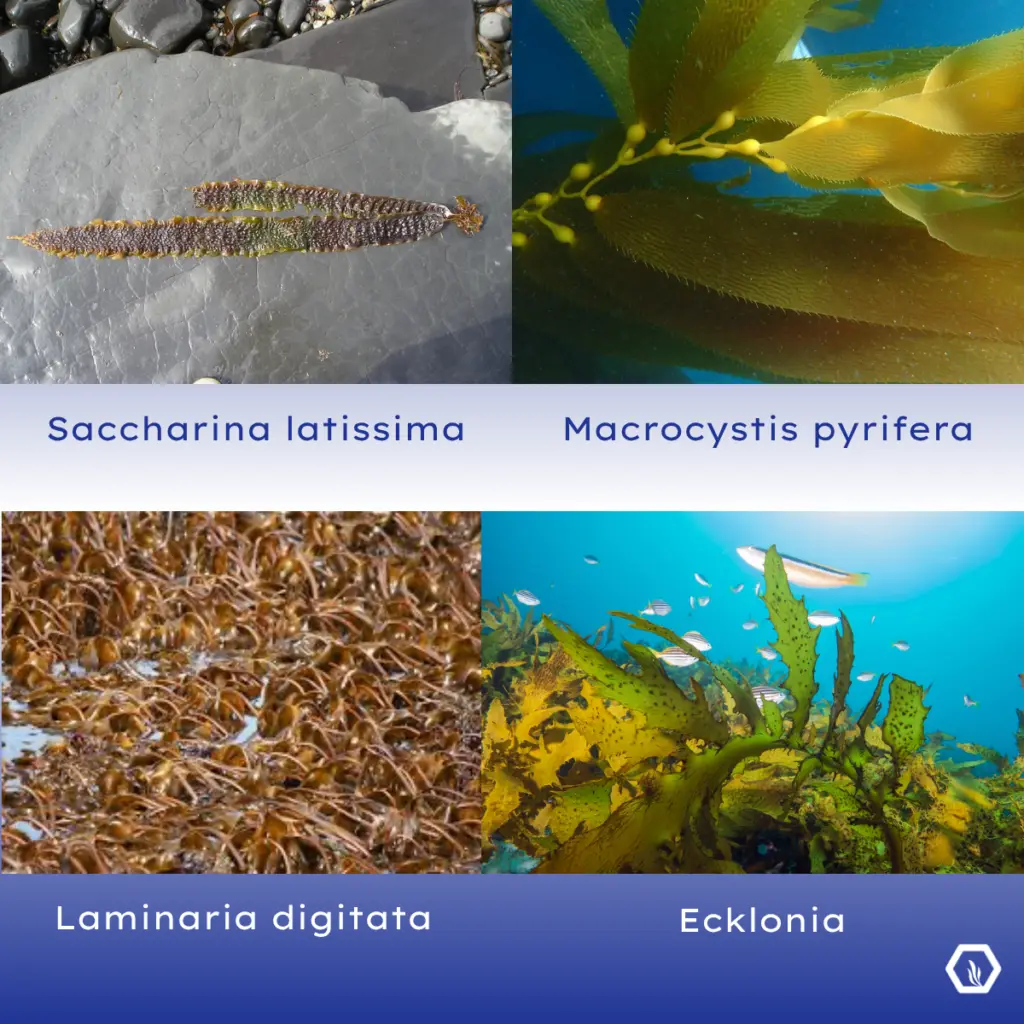
The most commercially relevant kelp species include:
Saccharina latissima (Sugar Kelp): mild flavour, widely used in food and feed applications across Northern Europe.
Laminaria digitata (Oarweed): a traditional source of iodine and alginates, harvested extensively along Atlantic coastlines.
Laminaria hyperborea: a major industrial species, particularly for alginate extraction.
Macrocystis pyrifera (Giant Kelp): sourced primarily from the Pacific coast, used in food, fertiliser, and aquaculture.
Laminaria ochroleuca (Golden Kelp): native to the northeastern Atlantic Ocean and Mediterranean Sea, increasingly studied and used for its bioactive compounds and alginate production.
Laminaria japonica (Saccharina japonica / Kombu): extensively cultivated in East Asia, highly prized as a culinary staple (kombu) and a major source of glutamic acid, iodine, and alginates.
Ecklonia spp.: common in Asian markets and increasingly in European aquafeed and cosmetics.
If you are sourcing kelp for a specific application, please specify the species. The nutritional profile, iodine content, texture, and processing behaviour vary considerably between them. Not sure which species fits your needs? Contact the Alganex team, we will help you identify the right match.
Things that are not kelp: The Rockweed and Wrack Confusion
Because “kelp” has become a highly marketable buzzword, brands frequently mislabel intertidal brown seaweeds like Ascophyllum nodosum (Knotted Wrack/Rockweed) and Fucus vesiculosus (Bladderwrack) as “Norwegian Kelp” or “Icelandic Kelp.” Biologically, these species belong to the order Fucales, making them distinctly different from true kelps (order Laminariales). This distinction is critical for formulators: true kelps can contain up to 9 to 10 times more iodinethan rockweeds. Misidentifying them in product formulations—especially for pet food or thyroid supplements—can lead to accidental iodine toxicity or a total failure to achieve intended functional and textural results.
Irish Moss: Chondrus crispus
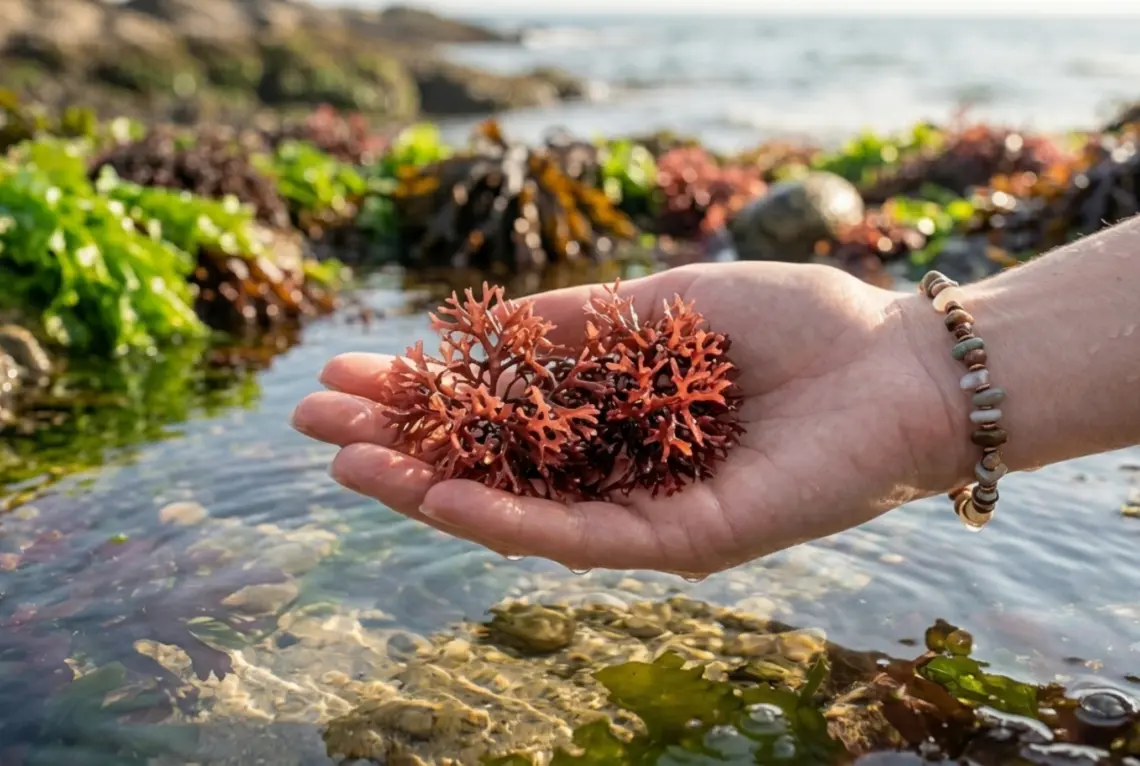
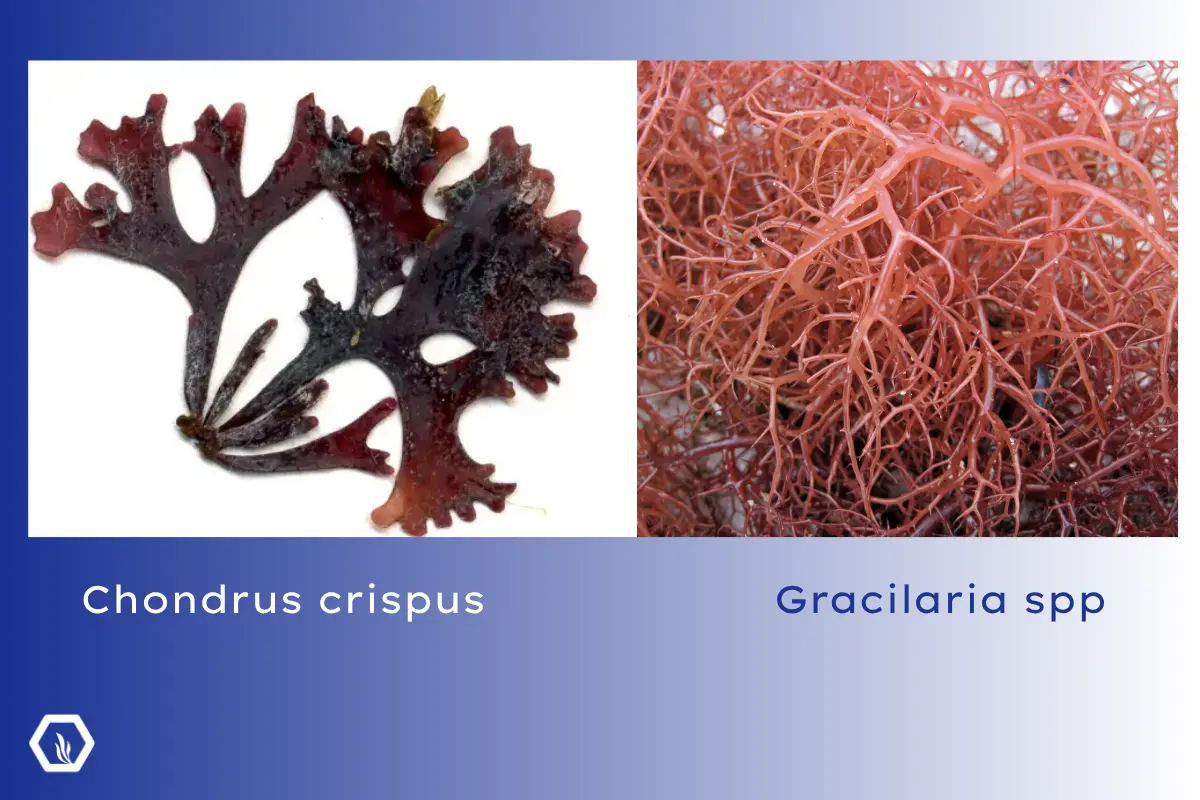
Irish Moss refers specifically to Chondrus crispus, a red seaweed native to the rocky Atlantic coastlines of Ireland, France, and the northeastern coast of North America. It has been used for centuries in traditional food preparation and is the original source of carrageenan.
Chondrus crispus is a temperate species. It does not grow in tropical waters. It has a distinct appearance (fan-shaped fronds, typically dark purple to green depending on light exposure) and a specific biochemical profile.
This is where a very common and commercially significant confusion arises.
Sea Moss: most commonly Gracilaria spp. or Eucheuma / Kappaphycus spp., sold as “Irish Moss”
“Sea moss” is a trade name that has become extremely widespread, particularly in wellness markets. The problem is that it is routinely used to describe tropical red seaweeds — most often Gracilaria species, or Eucheuma cottonii (Kappaphycus alvarezii) and Eucheuma spinosum — that are harvested or cultivated in warm waters in the Caribbean, West Africa, Southeast Asia, and the Pacific.
These species are not Chondrus crispus. They are distinct organisms with different growing environments, different biochemical compositions, and different functional properties.
The overlap in common names has created a situation where many consumers and buyers believe they are purchasing traditional Irish Moss (Chondrus crispus) when they are in fact receiving a tropical Gracilaria or Eucheuma product. Both have legitimate uses and genuine value — but they are not interchangeable, and mislabelling or vague naming creates problems for formulators, quality control teams, and end consumers alike.
At Alganex, we always identify products by their Latin species name. If you are purchasing what is being sold as “sea moss” or “Irish moss,” ask for the species confirmation.
Wakame & Atlantic Wakame: Undaria pinnatifida & Alaria esculenta
Wakame refers specifically to Undaria pinnatifida, a brown seaweed originating from Japan and Korea, now also cultivated in France, Spain, and New Zealand. It is widely used in soups, salads, and as a food ingredient, and is increasingly relevant in functional food and cosmetics for its fucoidan content.
A common misconception worth addressing: “Atlantic Wakame” is not Undaria pinnatifida sourced from the Atlantic Ocean. It is an entirely different species — Alaria esculenta — native to the cold rocky coastlines of Ireland, Scotland, Norway, Iceland, and the Faroe Islands. The name was adopted as a trade name due to a broadly similar appearance and flavour profile, but the two are distinct organisms belonging to different genera, with different biochemical compositions and potentially different functional properties depending on your application.
If you are formulating or sourcing based on wakame, always confirm the Latin species name. Undaria pinnatifida and Alaria esculenta are not interchangeable.
A Note on Naming (and How to Protect Your Formulation)
The algae industry is global, and common names follow regional traditions rather than scientific logic. For instance, “Dulse” means Palmaria palmata in Ireland and Scotland but is applied loosely to other red seaweeds elsewhere, while “Nori” (Pyropia/Porphyra) specifications vary wildly by market.
Vague naming isn’t just a marketing headache — it is a compliance and quality control risk. That is why we recommend that buyers always demand the Latin binomial name.
At Alganex, we eliminate the guesswork. Every single batch of biomass we source, process, or supply comes with a strict Latin species certification. We verify the exact organism so your formulation remains consistent, safe, and legally compliant.
If you are unsure which species fits your specific functional profile or target market, don’t leave it to chance. Contact the Alganex technical team today — we will audit your product requirements and guarantee you get the exact algae species your business demands.
References:
Guiry, M. D., & Guiry, G. M. (2025). AlgaeBase [World-wide electronic publication]. National University of Ireland. https://www.algaebase.org
Nitschke, U., Dixneuf, S., Ruth, A. A., Schmid, M., Manley, S. L., & Stengel, D. B. (2016). Variability in iodine in temperate seaweeds and iodine accumulation kinetics of Fucus vesiculosus and Laminaria digitata (Phaeophyceae, Ochrophyta). Journal of Phycology, 52(3), 436–449. https://pubmed.ncbi.nlm.nih.gov/29130494/
Blikra, M. J., Andersen, T., Aakre, I., & Kjellevold, M. (2022). Iodine from brown algae in human nutrition, with an emphasis on bioaccessibility, bioavailability, chemistry, and effects of processing: A systematic review. Comprehensive Reviews in Food Science and Food Safety, 21(2), 1517–1554. https://doi.org/10.1111/1541-4337.12918
Stengel, D. B., Connan, S., & Popper, Z. A. (2011). Algal chemodiversity and bioactivity: Sources of natural variability and implications for commercial application. Biotechnology Advances, 29(5), 483–501. https://doi.org/10.1016/j.biotechadv.2011.05.016
Lane, C. E., Mayes, C., Druehl, L. D., & Saunders, G. W. (2006). A multi-gene molecular investigation of the kelp (Laminariales, Phaeophyceae) supports substantial taxonomic re-organisation. Journal of Phycology, 42(2), 493–512. https://doi.org/10.1111/j.1529-8817.2006.00204.x



Comments by [email protected]